
“Secure the Blessings of Liberty” means protecting the benefits of freedom, for the people alive in 1787 and for future generations. It is one of the goals the framers listed in the Preamble to the U.S. Constitution, and it is the last and broadest of them.
The phrase has stayed in American public life because it describes what the Constitution is for. This article explains the full Preamble, the meaning of each key word, what the framers meant by liberty, who actually shared in those blessings, and how the phrase works in law and in daily civic life.
The Full Text of the Preamble
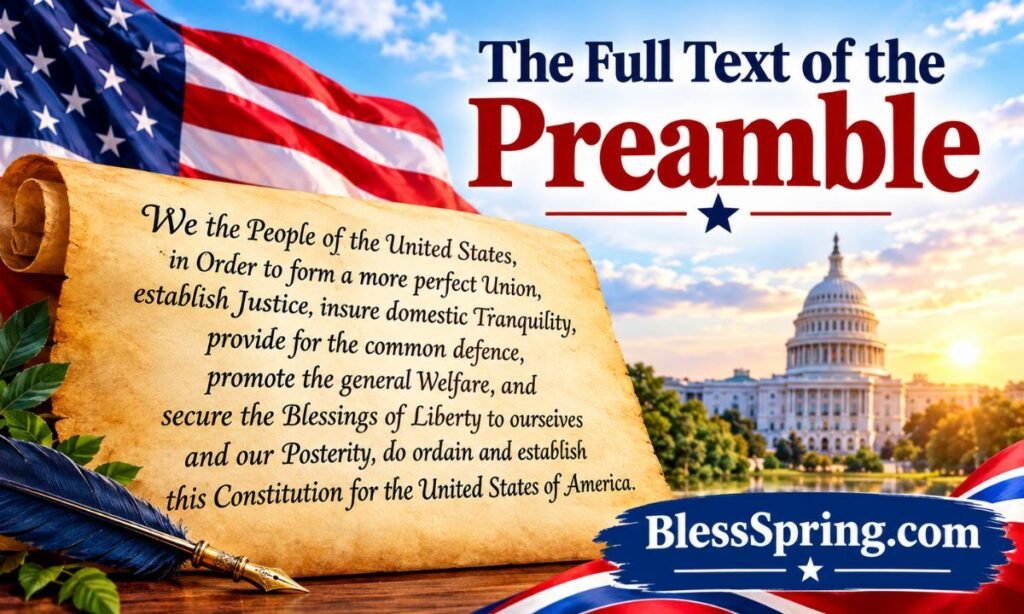
The Preamble is a single sentence that opens the Constitution. It was signed on September 17, 1787, and the Constitution took effect after ratification in 1788-1789.
We the People of the United States, in Order to form a more perfect Union, establish Justice, insure domestic Tranquility, provide for the common defence, promote the general Welfare, and secure the Blessings of Liberty to ourselves and our Posterity, do ordain and establish this Constitution for the United States of America.
The sentence names six goals:
- Form a more perfect Union
- Establish Justice
- Insure domestic Tranquility
- Provide for the common defence
- Promote the general Welfare
- Secure the Blessings of Liberty
The Constitutional Convention’s Committee of Style produced this final wording, and Gouverneur Morris of Pennsylvania is widely credited with shaping its language. An earlier draft had listed the individual states. The final version opens with “We the People,” which places the source of the government’s authority in the people.
What Each Word Means
Reading the phrase one word at a time clarifies the whole thing.
- Secure: To make safe and lasting. The framers did not say “create” liberty. They treated it as something people already held that needed protection.
- Blessings: Benefits or advantages. The word is used in a general sense here, and the Constitution itself does not mention God.
- Liberty: Freedom from arbitrary government power, along with the ability to live, speak, worship, and work without unjust interference.
- Ourselves: The generation that wrote and ratified the Constitution.
- Posterity: Descendants and future generations.
Put together, the phrase says the government exists to guard the advantages of freedom for the present and the future.
What the Founders Meant by Liberty
In the founding era, liberty usually meant freedom from tyranny, especially the kind of unchecked power colonists believed they had endured under British rule. It was tied to self-government, the rule of law, and protection of personal rights such as property and conscience.
The Declaration of Independence in 1776 had already named liberty among the unalienable rights, alongside life and the pursuit of happiness. The Preamble carries that thinking into the structure of a government.
Liberty did not mean doing anything one pleased. The framers expected laws, courts, and a shared public order to limit liberty in some ways in order to protect it for everyone. Historians and legal scholars still debate where that balance sits, and the debate is part of American history.
“To Ourselves and Our Posterity”
This clause turns the Constitution into a promise across generations. The framers were not writing only for their own time. They designed a government meant to last.
That long view helps explain several features of the document:
- A formal amendment process in Article V, so the Constitution can change without being thrown out
- Staggered terms for officials, so the whole government is not replaced at once
- Written limits on power, which future generations can read and enforce
The word “posterity” also carries a responsibility. Each generation receives the benefits of liberty and is expected to pass them on.
Who Shared in These Blessings?
In 1787, many people did not. This is a central and honest part of the story.
The original Constitution accepted slavery without using the word. It counted enslaved people as three-fifths of a person for representation (Article I, Section 2), allowed the slave trade to continue until at least 1808, and required the return of people who escaped slavery (Article IV). Women could not vote under most state laws, and voting rights in the early republic were commonly limited by property and other rules. Native Americans were generally not treated as citizens.
The meaning of “ourselves and our posterity” has widened over time through change and struggle:
- 1865: The 13th Amendment abolished slavery.
- 1868: The 14th Amendment defined citizenship and guaranteed equal protection of the laws.
- 1870: The 15th Amendment barred denying the vote on the basis of race.
- 1920: The 19th Amendment protected women’s right to vote.
Many Americans see this as the Preamble’s ideals gradually being applied to more people. Others emphasize how long the gap between promise and practice lasted. Both points are part of an accurate picture.
Does the Preamble Itself Give Rights?
No. The Preamble states purposes, but it does not create enforceable rights or powers. Courts have long treated it as a guide to the framers’ intentions rather than as a source of legal authority.
The Supreme Court made this point in Jacobson v. Massachusetts (1905), saying the Preamble has never been regarded as the source of any substantive power conferred on the government. Rights and powers come from the articles and amendments that follow.
The Preamble is still useful. It helps explain why the rest of the Constitution exists, and readers often turn to it when they want the framers’ overall aims.
How the Government Is Designed to Protect Liberty
The Constitution does not simply declare liberty. It builds structures meant to protect it.
- Separation of powers: Authority is divided among Congress, the President, and the courts so no single branch holds it all.
- Checks and balances: Each branch can limit the others, such as through vetoes, judicial review, and Senate confirmation.
- Federalism: Power is shared between the national government and the states.
- The Bill of Rights: Ratified in 1791, the first ten amendments protect freedoms such as speech, religion, the press, and fair legal process.
- Elections: Regular votes let the people replace officials.
- An independent judiciary: Courts can review laws and government actions against the Constitution.
The framers’ view was that dividing power makes abuse harder. The tradeoff is that government can move slowly, which people have long argued is partly the point.
How Citizens Help Secure Liberty Today

Securing liberty is not only a job for government. A constitutional system depends on people taking part.
- Vote in local, state, and national elections.
- Serve on a jury when called, which is a direct way citizens apply the law.
- Stay informed by reading reliable sources and comparing perspectives.
- Contact elected officials and take part in public meetings.
- Use First Amendment freedoms to speak, assemble, and petition peacefully.
- Respect others’ rights, including those of people with whom you disagree.
- Learn the Constitution, since people protect rights more effectively when they know them.
Different Americans disagree about which policies best protect liberty, and that disagreement is itself part of living in a free society.
Why the Word “Blessings” Stands Out
The word “blessings” can sound religious, which makes it stand out in a document that is otherwise legal and practical. In this sentence it most likely means benefits or good things, not a formal religious claim.
The Constitution does not mention God. Article VI says no religious test may be required for any federal office, and the First Amendment later protects the free exercise of religion and bars an established national church. The framers held a range of religious views, from devout Christians to deists to skeptics, and the language of the Preamble was written to be broadly shared.
Calling liberty a “blessing” also suggests it is valuable and not guaranteed. A blessing can be lost if it is not protected, which fits the verb “secure.”
Frequently Asked Questions
What does “secure the blessings of liberty” mean in simple words?
It means protecting the benefits of freedom. The goal was to keep those benefits safe for the framers’ generation and for future ones.
Where does the phrase “blessings of liberty” appear?
It appears in the Preamble to the U.S. Constitution. It is the last of the six purposes listed in that opening sentence.
Does the Preamble give Americans legal rights?
No. The Preamble states goals but does not create enforceable rights. Rights come from the Constitution’s articles and amendments, such as the Bill of Rights.
What does “posterity” mean in the Preamble?
Posterity means future generations. The phrase shows the framers meant the Constitution to protect liberty for the long term, not just their own time.
Did everyone enjoy these blessings when the Constitution was written?
No. Enslaved people, most women, and many others were excluded from full rights in 1787. Constitutional amendments and long civic struggles expanded who is covered.
Conclusion
To “secure the Blessings of Liberty” is to protect the benefits of freedom and keep them safe for the future. The phrase closes the Preamble and sums up much of what the Constitution was built to do.
Its meaning has two sides. The ideal was broad, but the original practice was narrow, and the work of closing that gap has shaped much of American history.
The Preamble does not itself grant rights, but it explains the purpose behind the structures, amendments, and protections that do. Understanding it makes the rest of the Constitution easier to read.
Liberty depends on people who understand it and take part in protecting it. If this article helped, share it with a student, teacher, or friend who is curious about the Constitution.

John Howdy is a dedicated author at Bless Spring with over four years of professional writing experience. He specializes in creating informative, engaging, and SEO-friendly content for a global online audience. His work focuses on delivering well-researched insights in a clear and reader-friendly style. Through Bless Spring, John consistently shares valuable articles that educate, inspire, and support digital readers.
