

Midnight prayers for spiritual warfare are prayers offered in the quiet hours of the night, asking God for protection, freedom, and victory over spiritual opposition. In this article, “dangerous” does not mean harmful to you. It means bold and powerful, the kind of prayer that takes evil seriously and takes God’s authority more seriously.
Below you will find seven well-known prayer themes, each with Bible references and a short sample prayer in original wording. You will also find guidance on praying wisely, warning signs to watch for, how different Christian traditions approach this topic, and answers to common questions.
Understanding “Dangerous” Midnight Prayers in Christian Context
In Christian use, a “dangerous” prayer is a bold prayer that confronts spiritual opposition in the name of Christ. The word is meant to describe boldness, not risk. Many believers use it for prayers that go beyond comfortable requests and ask God to break chains, expose darkness, and restore what was lost.
The idea rests on a few Bible passages. Ephesians 6:12 says the believer’s struggle is not against flesh and blood but against spiritual forces. 2 Corinthians 10:4 describes spiritual weapons that have divine power. 1 Peter 5:8 warns believers to stay alert because the adversary prowls like a lion.
Christians do not all agree on how much weight to give “spiritual warfare” language. Some traditions emphasize it heavily, while others stress that Christ’s victory is already complete and that prayer is mainly trust, not combat. This article presents the common approaches and notes where traditions differ.
One more point matters here. A prayer is not a magic formula. Its power, in the Christian view, comes from God’s character and Christ’s work, not from special wording or a particular hour.
Why Midnight Prayer is Spiritually Significant
Midnight prayer is significant because the Bible links the middle of the night with both crisis and divine action. It is not required for effective prayer, but many Christians find the hour meaningful.
Several passages connect midnight with God’s work:
- Psalm 119:62: The psalmist says he rises at midnight to give thanks to God.
- Acts 16:25-26: Paul and Silas were praying and singing hymns around midnight in prison when an earthquake opened the doors and loosened the chains.
- Exodus 12:29: The final plague in Egypt struck at midnight, leading to Israel’s release.
- Matthew 25:6: In Jesus’ parable of the ten virgins, the cry announcing the bridegroom comes at midnight.
- Mark 13:35: Jesus tells his followers to stay watchful, naming evening, midnight, rooster crow, and morning.
There are practical reasons as well. The night is quiet, distractions are fewer, and many people find it easier to focus. Luke 6:12 records that Jesus spent a whole night in prayer before choosing his apostles.
These passages describe events, not a rule that spiritual warfare must happen at 12:00 a.m. Most Christian teachers say God hears prayer at every hour, and that midnight is simply a time many believers set aside.
1. The Blood of Jesus Prayer
This prayer asks for protection and cleansing based on Christ’s sacrifice on the cross. It is among the most widely used warfare prayers across Christian traditions.
The foundation is Revelation 12:11, which says believers overcame the accuser by the blood of the Lamb and the word of their testimony. Other key passages include Ephesians 1:7 (redemption through his blood), 1 John 1:7 (the blood of Jesus cleanses from sin), and Hebrews 9:14 (his blood cleanses the conscience). The Passover story in Exodus 12:13, where blood on the doorposts marked homes for protection, is often cited as a picture of this.
Christians differ in how they express this. Evangelical and Pentecostal believers often pray it aloud over family, home, and mind. Catholic and Orthodox believers more often connect Christ’s sacrifice with the Eucharist and the prayers of the Church. In every case, the core meaning is trust in Christ’s atoning work, not the repetition of a phrase.
Sample prayer: Lord Jesus, I trust in your sacrifice for me. Cover my home, my family, and my mind with your protection. Cleanse me of guilt and fear, and let me rest in the finished work of the cross. Amen.
2. The Name of Jesus Prayer
This prayer appeals to the authority of Jesus’ name. Philippians 2:9-10 says God gave Jesus the name above every name, so that every knee will bow at it. Acts 4:12 teaches that salvation is found in no other name, and John 14:13-14 records Jesus inviting his followers to ask in his name.
The New Testament shows the name used in healing and deliverance. Acts 3:6 records Peter healing a man in the name of Jesus Christ, and Mark 16:17 lists casting out demons in his name among the signs that accompany believers.
There is also a clear warning. In Acts 19:13-16, some travelling exorcists tried to use Jesus’ name without belonging to him, and they were overpowered. Many pastors read this as proof that the name is not a spell. It is the name of a person, and the one praying is meant to be in relationship with him.
Sample prayer: In the name of Jesus, I ask for peace over this house tonight. I submit myself to you, Lord, and I stand on your authority, not my own. Let every fear bow to your name. Amen.
3. The Fire of God Prayer
This prayer asks God to purify, strengthen, and renew through his presence. Fire is a repeated biblical symbol of God. Hebrews 12:29 calls God a consuming fire, Malachi 3:2-3 speaks of a refiner’s fire, and Acts 2:3-4 describes tongues of fire resting on believers at Pentecost.
The Old Testament scene on Mount Carmel is often quoted. In 1 Kings 18:38, fire from the Lord fell on Elijah’s sacrifice. Another passage, Leviticus 6:12-13, says the fire on the altar was never to go out, which many Christians apply to a continually burning prayer life.
A careful reading matters here. In Luke 9:54-55, two disciples asked whether they should call down fire on a village that rejected Jesus, and he rebuked them. For this reason, many teachers say the “fire” in prayer should refer to purification and God’s presence, not harm to people.
Sample prayer: Holy Spirit, burn away what does not belong in me: bitterness, pride, and fear. Rekindle my faith and renew my love for you. Let your presence fill this place. Amen.
4. The Psalm 35 Warfare Prayer
This prayer is built on Psalm 35, a psalm of David asking God to defend him against those who oppose him. It begins with an appeal for the Lord to contend with those who contend with him and to fight those who fight him.
The psalm includes several themes believers draw on:
- A request for God to be a shield and protector (verses 2-3)
- A plea for God to say to the soul that he is its salvation (verse 3)
- Praise for God’s rescue of the weak (verses 9-10)
- A reminder that David had prayed and fasted for his enemies when they were ill (verse 13)
Some verses in this psalm are strong and ask for enemies to be put to shame. Scholars call these imprecatory elements. Most Christian interpreters balance them with Matthew 5:44, where Jesus tells his followers to pray for their enemies, and Ephesians 6:12, which says the true struggle is spiritual, not against people.
Sample prayer: Lord, you see what I am facing. Contend for me, defend me, and speak peace to my soul. Rescue me from lies and from fear, and teach me to pray for those who oppose me. Amen.
5. The Stronghold Breaking Prayer
This prayer targets deep-rooted patterns that hold a person back. 2 Corinthians 10:4-5 speaks of divinely powerful weapons that demolish strongholds, arguments, and every thought set against the knowledge of God.
Many Christians understand “strongholds” as lasting habits, fears, addictions, or ways of thinking that feel impossible to escape. Others also include spiritual oppression in the meaning. Either way, the passage points to the mind as a central battleground, and Romans 12:2 adds that transformation comes through the renewing of the mind.
For that reason, this prayer usually works best alongside practical steps. These can include honest confession, accountability with a trusted believer, Scripture reading, and professional counseling when struggles are heavy.
Sample prayer: Father, I name the patterns that have held me: [name them honestly]. I give them to you. Break their grip, renew my mind, and surround me with people who will help me walk free. Amen.
6. The Deliverance and Freedom Prayer
This prayer asks God for freedom from bondage, whether spiritual, emotional, or behavioral. Jesus described his mission in Luke 4:18 as proclaiming freedom for prisoners and setting the oppressed free. John 8:36 says that those the Son sets free are free indeed, and Galatians 5:1 urges believers to stand firm in that freedom.
The Gospels record Jesus delivering people from demonic oppression, including the man in Mark 5:1-20. Psalm 107:14 gives a general picture of God bringing people out of darkness and breaking their chains.
Honest confession often goes with this prayer. 1 John 1:9 promises forgiveness to those who confess their sins. Christians also stress that not every struggle is demonic. Anxiety, depression, trauma, and addiction can have medical and psychological causes, and seeking a doctor or counselor is fully compatible with faith.
Sample prayer: Lord Jesus, you came to set captives free. I bring you what binds me, and I ask for your freedom. Lead me to the right people, the right help, and the right next step. Amen.
7. The Divine Judgment Prayer
This prayer appeals to God as the righteous judge who sees injustice and acts. It is the most sensitive of the seven and the easiest to misuse.
The Bible does contain prayers that call on God to bring justice. Psalm 94:1-2 calls on the God of vengeance to rise up and repay the proud. Genesis 18:25 asks whether the Judge of all the earth will do right. Revelation 6:10 shows believers asking God how long until justice comes.
At the same time, the New Testament instructs believers not to take revenge. Romans 12:19 says vengeance belongs to the Lord. Luke 23:34 records Jesus asking forgiveness for those who crucified him. Jude 9 notes that even the archangel Michael did not bring a slanderous accusation against the devil but left the matter to the Lord.
For this reason, wise teachers advise praying for justice, truth, and protection, and not asking for harm to specific people. Prayer is meant to place the matter in God’s hands, not to wish disaster on a neighbor, relative, or coworker.
Sample prayer: Righteous God, you see every injustice. I place this situation in your hands. Bring truth to light, protect the vulnerable, and bring repentance and mercy where it is needed. Keep my own heart free of hatred. Amen.
How to Pray These Dangerous Prayers Safely
Praying boldly works best when it is grounded and healthy. These four principles help keep spiritual warfare prayer balanced.
Ensure Spiritual Covering
“Spiritual covering” usually means being connected to a local church, pastor, or mature believers who can offer guidance and accountability. Proverbs 11:14 notes that there is safety in many counselors.
Praying alone is not wrong, and Jesus himself withdrew to pray alone. The point is that believers should not isolate themselves, especially when facing heavy struggles.
Use Biblical Authority
When Jesus faced temptation in Matthew 4, he answered each challenge with Scripture. Praying with Bible passages keeps prayer anchored in what God has said instead of in personal impressions.
James 4:7 puts the order clearly: submit to God first, then resist the devil. Authority is received from God. It is not claimed apart from him.
Maintain Spiritual Discipline
Consistent habits matter more than dramatic one-time prayers. Regular Bible reading, worship, rest, and fellowship build a stable foundation.
Be sensible about the body. Regularly giving up sleep can leave you drained and anxious, and anyone considering fasting with a health condition should speak with a doctor first. Midnight prayer works better as an occasional practice than as an exhausting routine.
Prepare Your Heart
Before praying, many Christians use Psalm 139:23-24 to ask God to search their hearts. Confession and forgiveness are central. In Mark 11:25, Jesus links prayer with forgiving others.
Praying from humility and peace, not fear or anger, keeps the focus on God instead of on the opposition.
Warning Signs During Dangerous Midnight Prayers
Warning signs show that a prayer practice may be becoming unhealthy. They do not prove anything spiritual by themselves. Fatigue, vivid dreams, and restlessness at night often have ordinary explanations such as stress, lack of sleep, or too much caffeine.
Watch for these signs:
- Constant fear or dread that grows instead of fading after prayer
- An obsession with demons or attacks, with every problem blamed on spiritual causes
- Ongoing sleep loss, exhaustion, or declining health
- Pulling away from family, friends, and church
- Praying for harm to specific people
- Leaders who demand payment for deliverance, require secrecy, or discourage you from seeing a doctor
- Strong feelings of anger, hatred, or superiority toward others
Some warning signs call for immediate help beyond prayer. If you experience persistent distress, hearing voices, panic, or thoughts of harming yourself or others, contact a medical professional, a mental health provider, or emergency services right away. Faith and professional care work together, and seeking help is not a lack of faith.
Healthy spiritual practice tends to produce peace, humility, and love, in line with Galatians 5:22-23. If a prayer routine produces the opposite, step back and talk with a trusted pastor or counselor.
Denominational Approaches to Dangerous Prayers
Christian traditions approach spiritual warfare differently. These summaries are general, and individual churches vary widely.
- Catholic: The Church recognizes spiritual evil and uses prayers such as the Prayer to St. Michael. Formal exorcism is reserved for authorized priests, usually with the bishop’s permission. Laypeople are encouraged to rely on the sacraments, the rosary, sacramentals, and the guidance of a priest.
- Orthodox: Spiritual struggle is part of regular church life through fasting, confession, the sign of the cross, and the Jesus Prayer. Blessings and prayers for protection are offered through the priest and the Church’s services.
- Pentecostal and charismatic: Deliverance ministry, prayers of binding and loosing, and direct warfare prayer are common. Many of these churches teach that believers can exercise authority over spiritual opposition through Christ.
- Baptist, Reformed, and other evangelical traditions: Many affirm that spiritual forces are real but stress that Christ has already won the decisive victory. They often emphasize Scripture, prayer, and holy living over specific warfare formulas, and some are cautious about “binding” language.
- Anglican, Lutheran, and Methodist: Practice varies. Many include prayers for protection and deliverance in their liturgies or services, while approaches to spiritual warfare differ widely between congregations.
No single tradition speaks for all Christians. If you belong to a church, it is wise to learn how your own tradition understands spiritual warfare before adopting practices from another.
Biblical Weapons for Dangerous Prayers
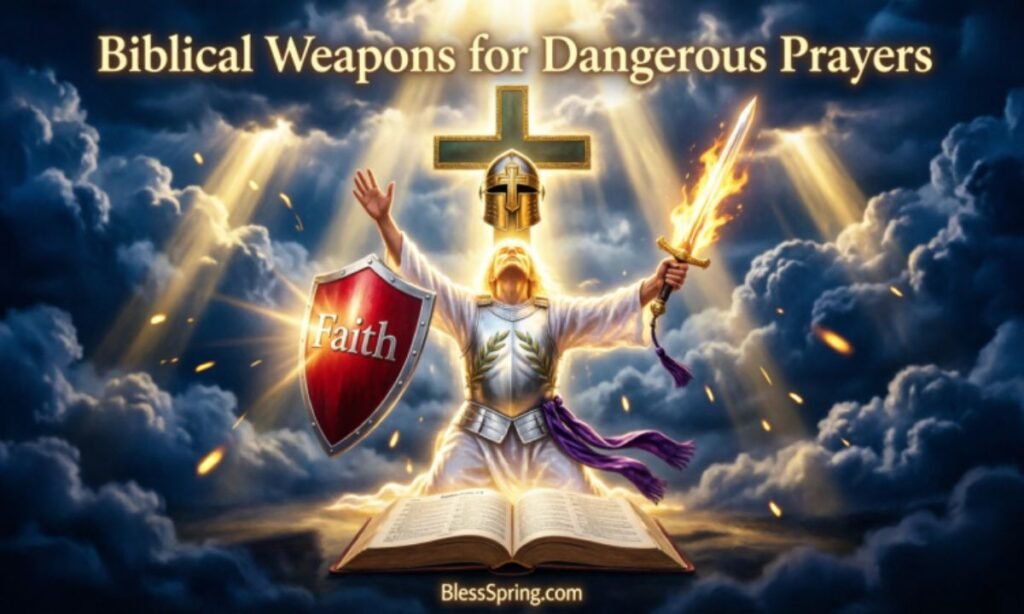
The Bible describes a set of spiritual resources for believers. The best-known list is the armor of God in Ephesians 6:13-18:
- Truth as a belt, holding everything together
- Righteousness as a breastplate, guarding the heart
- The gospel of peace as shoes, giving readiness and stability
- Faith as a shield, protecting against fiery attacks
- Salvation as a helmet, protecting the mind
- The word of God as the sword of the Spirit, the one offensive piece
- Prayer at all times in the Spirit
Other biblical resources support these:
- Scripture: Hebrews 4:12 describes God’s word as living and active.
- Praise and worship: In 2 Chronicles 20:21-22, singers went ahead of the army, and the Lord gave victory. Paul and Silas also sang in prison in Acts 16.
- Testimony: Revelation 12:11 links overcoming with the word of the believer’s testimony.
- Fasting: Scripture presents fasting as a way to humble oneself before God, as in Joel 2:12, though it should be practiced wisely.
- Community: Ecclesiastes 4:12 says a cord of three strands is not quickly broken, a picture many apply to praying with others.
Notice that the list centers on character and trust in God. In the Christian view, the strongest weapons are truth, faith, and prayer, not loud words or elaborate rituals.
Frequently Asked Questions
What are midnight prayers for spiritual warfare?
Midnight prayers for spiritual warfare are prayers offered late at night asking God for protection, deliverance, and strength against spiritual opposition. They draw on passages such as Acts 16:25-26 and Ephesians 6:12. Many Christians pray them on special occasions or during hard seasons.
Is midnight prayer mentioned in the Bible?
Yes, midnight is mentioned in connection with prayer and worship. Psalm 119:62 speaks of rising at midnight to give thanks, and Acts 16:25 describes Paul and Silas praying and singing around midnight. The Bible does not, however, command that spiritual warfare prayer be offered at midnight.
Are “dangerous” prayers actually dangerous?
No, the term describes boldness, not harm. A prayer is considered “dangerous” because it confronts darkness and asks God for dramatic change. The real risks are unhealthy habits such as fear, isolation, or lack of sleep, which is why balance and community matter.
Do I have to pray at exactly midnight for it to work?
No, Christians generally teach that God hears prayer at any hour. Midnight is a meaningful time for many people because it is quiet, but the effectiveness of prayer is understood to depend on God, not the clock. Pray when you can focus and stay healthy.
Is it right to pray against specific people?
Most Christian teachers say no. Jesus told his followers in Matthew 5:44 to pray for their enemies, and Romans 12:19 leaves vengeance to God. It is better to pray for protection, justice, and the other person’s repentance than to ask for harm.
How do Catholics approach spiritual warfare prayer?
Catholics generally rely on the sacraments, the rosary, and prayers such as the Prayer to St. Michael. Formal exorcism is performed only by authorized priests. Laypeople are usually encouraged to seek a priest’s guidance for serious concerns.
Can anyone pray these prayers, or only pastors?
Most Christian traditions teach that any believer can pray for protection and freedom. Some, such as the Catholic and Orthodox churches, reserve specific rites like exorcism for clergy. For heavy or ongoing struggles, many pastors recommend praying with trusted believers and seeking pastoral and professional support.
Conclusion
Midnight prayers for spiritual warfare draw on a long Christian tradition of seeking God in the quiet hours. The seven themes covered here, from the blood and name of Jesus to deliverance and divine justice, all point to the same center: trust in God’s power, not in a formula.
The Bible gives clear guidance for approaching them well. Pray with Scripture, stay humble, forgive others, and avoid asking for harm to anyone. Remember that Christian traditions differ in how they understand and practice this kind of prayer.
Balance matters just as much as boldness. Rest, community, pastoral care, and professional help for physical or mental struggles are all part of a healthy spiritual life. No prayer replaces them, and they do not weaken your faith.
If you choose to pray at midnight, begin with peace and not fear. Whether you use these prayers as written or in your own words, may your nights be marked by trust, your heart by freedom, and your days by God’s steady presence.

John Howdy is a dedicated author at Bless Spring with over four years of professional writing experience. He specializes in creating informative, engaging, and SEO-friendly content for a global online audience. His work focuses on delivering well-researched insights in a clear and reader-friendly style. Through Bless Spring, John consistently shares valuable articles that educate, inspire, and support digital readers.
