

Few phrases in American history carry as much quiet weight as “secure the blessings of liberty.” Tucked into the closing lines of the Preamble to the United States Constitution, this phrase has shaped the way generations of Americans think about freedom, government, and responsibility. It’s short, almost poetic, yet it holds an entire philosophy of self-governance within its words.
This article breaks down what the phrase actually means, why the Founders chose these specific words, and how the idea of “securing liberty” still plays out in everyday American life today. Whether you’re a student studying the Constitution, a teacher preparing a lesson, or simply someone curious about the deeper meaning behind these founding words, this guide walks through it all in plain, understandable language.
Understanding the Preamble and Its Purpose
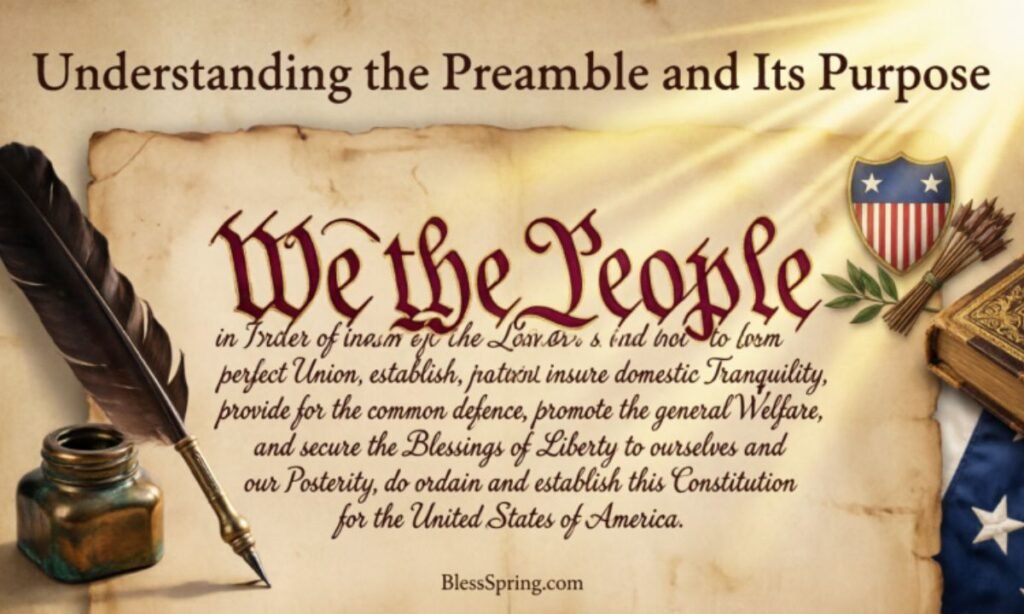
The Preamble is the introduction to the U.S. Constitution, and while it doesn’t carry legal authority on its own, it sets the tone and purpose for everything that follows. It reads: “We the People of the United States, in Order to form a more perfect Union, establish Justice, insure domestic Tranquility, provide for the common defence, promote the general Welfare, and secure the Blessings of Liberty to ourselves and our Posterity, do ordain and establish this Constitution for the United States of America.”
Each phrase in the Preamble represents a core goal the Founders had for the new nation. Forming a more perfect union meant strengthening the bond between states. Establishing justice meant creating a fair legal system. Ensuring domestic tranquility meant maintaining peace within the country. Providing for the common defense meant protecting the nation from outside threats. Promoting the general welfare meant supporting the wellbeing of citizens. And finally, securing the blessings of liberty meant protecting freedom itself, not just for the founding generation, but for every generation that would follow.
The Preamble essentially works as a mission statement. It doesn’t grant specific powers or rights, but it explains why the Constitution exists in the first place. Understanding this context is key to understanding why the phrase about liberty carries so much significance.
The Meaning of “Blessings of Liberty”
The word “blessings” in this context doesn’t necessarily carry a religious meaning, though it can be interpreted that way depending on perspective. More broadly, it refers to the benefits, gifts, or positive outcomes that come from living in a free society. Liberty itself refers to freedom from oppressive control, whether that control comes from a king, a foreign power, or an overreaching government.
Put together, “blessings of liberty” describes the advantages and privileges that come with being free: the ability to speak one’s mind, practice a chosen religion, own property, participate in government, and live without fear of unjust punishment. These aren’t abstract ideas to the Founders. Many of them had lived under British rule, where such freedoms were often restricted or controlled by the crown.
The phrase suggests that liberty isn’t just a legal status; it’s something valuable enough to be treated as a gift, one that needs to be protected and passed down. This framing turns liberty into something active rather than passive. It’s not just a right that exists on paper. It’s something that has to be secured, meaning actively defended and maintained.
To Ourselves and Our Posterity: What It Really Means
One of the most forward-thinking parts of this phrase is the inclusion of “posterity,” meaning future generations. The Founders weren’t only concerned with securing liberty for the people alive in 1787. They were thinking generations ahead, to people who hadn’t even been born yet.
This is a significant detail because it shows that the Constitution was designed to be a living framework, not a temporary fix for a single era. The Founders understood that freedom, once won, isn’t automatically permanent. Societies can slide back into tyranny, corruption, or authoritarian control if citizens stop actively protecting their rights.
By writing “to ourselves and our Posterity,” the authors of the Constitution were essentially saying: this document isn’t just for us, it’s for our children, our grandchildren, and every American who comes after. That single phrase places a responsibility on every generation to continue protecting the freedoms the Constitution establishes, rather than assuming those freedoms will simply take care of themselves.
What Does Liberty Mean in the Preamble?
Liberty in the context of the Preamble refers to more than just the absence of restriction. It represents the right to self-governance, personal freedom, and protection from abuse of power. During the time the Constitution was written, liberty was closely tied to the idea of independence from British rule, but it extended further into a broader vision of individual rights.
In practical terms, liberty as referenced in the Preamble includes:
- Freedom of speech and expression
- Freedom of religion
- The right to a fair trial
- Protection from unreasonable searches and seizures
- The right to participate in government through voting and civic engagement
- Protection of property rights
It’s worth noting that the Preamble itself doesn’t list these rights specifically. Those detailed protections come later, primarily through the Bill of Rights and subsequent amendments. The Preamble instead introduces the concept of liberty as a guiding value, one that the rest of the Constitution is designed to protect and structure around.
The Founders’ Vision: Securing Freedom for All
When the Founders wrote about securing liberty, their vision was shaped heavily by their experiences under British colonial rule. They had witnessed firsthand what happens when a government has too much unchecked power: taxation without representation, restricted speech, and limited say in local governance.
Their solution was to create a system of government built on checks and balances, where no single branch or individual could hold too much control. This structure, divided among the legislative, executive, and judicial branches, was designed specifically to prevent the kind of concentrated power that had led to their grievances with the British crown.
It’s important to acknowledge, though, that the Founders’ vision of liberty was not equally applied to all people at the time. Enslaved individuals, women, and Indigenous peoples were largely excluded from the freedoms described in the Constitution when it was first written. The story of American liberty since then has, in many ways, been the story of expanding that original vision to include more people through amendments, court decisions, and social movements. Understanding this history adds important context to how the phrase “secure the blessings of liberty” has evolved in meaning over time.
How the Government Works to Secure the Blessings of Liberty
The U.S. government uses several structural tools to protect liberty on an ongoing basis. These aren’t just abstract ideals; they’re built into the actual mechanics of how the government functions.
- Separation of powers divides authority among three branches of government, preventing any single branch from becoming too powerful.
- Checks and balances allow each branch to limit the powers of the others, creating built-in accountability.
- The Bill of Rights explicitly protects fundamental freedoms such as speech, religion, assembly, and due process.
- Judicial review allows courts to strike down laws or actions that violate constitutional rights.
- Regular elections give citizens the power to remove leaders who fail to protect their freedoms or who abuse their authority.
- Federalism divides power between national and state governments, preventing over-centralization of authority.
Each of these mechanisms works together to create a system where liberty isn’t dependent on the goodwill of any single leader or institution. Instead, it’s protected through structure, process, and the ongoing participation of citizens.
Examples of Securing the Blessings of Liberty in Everyday Life
While the phrase itself sounds formal and historical, the concept it represents shows up in everyday American life in ways that are easy to overlook. Consider the following examples:
- Being able to voice disagreement with government policy without fear of arrest reflects protected freedom of speech.
- Practicing any religion, or no religion at all, without government interference reflects freedom of religion.
- Voting in local, state, and national elections reflects the right to participate in self-governance.
- Being entitled to a fair trial with legal representation reflects due process protections.
- Owning a home or business without arbitrary government seizure reflects property rights protections.
- Reading a news article critical of elected officials reflects freedom of the press.
These everyday freedoms often go unnoticed simply because they’re so deeply embedded in American life. But each one traces back, in some way, to the constitutional framework designed to secure liberty for citizens.
The Responsibility of Citizens in Preserving Liberty
Securing liberty isn’t solely the government’s job. The Constitution places responsibility on citizens as well, since a democratic system only functions properly when people actively participate in it. This responsibility can take many forms.
Voting is one of the most direct ways citizens participate in preserving liberty, since elected officials are accountable to the people who choose them. Serving on juries helps maintain a fair judicial system, ensuring that legal decisions reflect community judgment rather than solely government authority. Staying informed about current events and policy decisions allows citizens to make educated choices at the ballot box. Engaging in peaceful protest or civic advocacy allows people to voice concerns and push for change when they believe liberty is being threatened.
Education also plays a major role in this responsibility. Understanding history, civics, and the structure of government helps citizens recognize when rights are being upheld or violated. Without an informed public, even the strongest constitutional protections can be weakened over time through neglect or lack of awareness.
The Connection Between Liberty and Justice
Liberty and justice are frequently mentioned together, and for good reason. Liberty without justice can lead to chaos or the unchecked freedom of some at the expense of others. Justice without liberty can lead to authoritarian control disguised as order. The two concepts are meant to balance each other.
In the Preamble, “establish Justice” comes before “secure the Blessings of Liberty,” which suggests these ideas were meant to work in tandem. A just legal system ensures that liberty is applied fairly and equally, rather than becoming a privilege reserved for a select few. Courts, laws, and legal protections exist to make sure that one person’s freedom doesn’t come at the unjust expense of another person’s rights.
This is why phrases like “liberty and justice for all,” found in the Pledge of Allegiance, echo the same values expressed in the Preamble. Liberty is most meaningful when it’s paired with a fair and equal system of justice that applies to everyone, not just a select group.
Why “Secure the Blessings of Liberty” Still Matters Today
More than two centuries after the Constitution was written, this phrase remains relevant because the challenges of protecting freedom haven’t disappeared. Modern debates over free speech, privacy rights, voting access, and government overreach all trace back to the same fundamental question the Founders were grappling with: how do you protect individual freedom while maintaining a functional, orderly society?
Every generation faces new tests of this balance. Technological advances raise new questions about privacy and surveillance. Political polarization raises questions about free speech and misinformation. Global events raise questions about national security versus civil liberties. In each of these cases, the underlying goal remains the same as it was in 1787: securing liberty, not just for the present moment, but for the generations that follow.
This is part of why civic education remains so important. Understanding phrases like “secure the blessings of liberty” isn’t just an academic exercise. It’s a reminder that liberty requires ongoing attention, participation, and protection. It was never meant to be something citizens simply inherit and forget about. It was designed to be something each generation actively works to preserve.
Frequently Asked Questions
What does “secure the blessings of liberty” mean in simple terms?
It means protecting the benefits and freedoms of living in a free society, not just for the people alive at the time the Constitution was written, but for future generations as well.
Why did the Founders include “posterity” in this phrase?
They wanted to emphasize that the Constitution and the liberty it protects were meant to last beyond their own generation, extending to future Americans as well.
Is the Preamble legally binding?
No, the Preamble itself doesn’t grant or restrict specific legal powers. It serves as an introduction that explains the purpose and goals behind the rest of the Constitution.
How does the government secure liberty today?
Through structures like separation of powers, checks and balances, the Bill of Rights, judicial review, and regular democratic elections that hold leaders accountable.
What’s the difference between liberty and freedom?
The terms are often used interchangeably, but liberty typically refers more specifically to freedom from oppressive control, especially in a political or governmental context.
Did the Founders’ idea of liberty apply to everyone in 1787?
No, the original vision of liberty in the Constitution excluded many groups, including enslaved people, women, and Indigenous peoples. Expanding these freedoms became an ongoing process through amendments and civil rights progress.
Why is this phrase still taught in schools today?
It’s a foundational part of understanding American government and civic responsibility, helping students understand both the origins and ongoing importance of protecting individual freedoms.
Conclusion
“Secure the blessings of liberty” is more than a historical phrase tucked into the Constitution’s Preamble. It represents a promise, one made by the Founders not just to their own generation, but to every American who would come after them. It reflects the idea that freedom isn’t something that simply exists on its own; it has to be actively protected through fair laws, balanced government structures, and engaged citizens.
Understanding this phrase means understanding the deeper responsibility that comes with living in a free society. Liberty isn’t static, and it isn’t guaranteed to last without effort. It requires ongoing participation, awareness, and protection from every generation that benefits from it. That’s exactly why these words, written over two centuries ago, continue to matter just as much today as they did when they were first put to paper.

John Howdy is a dedicated author at Bless Spring with over four years of professional writing experience. He specializes in creating informative, engaging, and SEO-friendly content for a global online audience. His work focuses on delivering well-researched insights in a clear and reader-friendly style. Through Bless Spring, John consistently shares valuable articles that educate, inspire, and support digital readers.
