

Every parent carries a quiet worry that never fully goes away. It sits in the back of the mind during the day and sometimes keeps you awake at night. Will my child be safe today? Will they make good choices? Will they be protected from things I cannot see or control? These questions are part of what it means to love a child, and in Islam, there is a beautiful and practical answer to this worry: dua. Making dua for the protection of children is one of the most powerful things a parent can do, and it is something every believer, regardless of how busy their life is, can practice daily.
This article walks through why parents turn to dua, how daily prayer supports a child’s growth, what protection truly means in Islamic teaching, and gives you real duas you can start using today. Whether your child is a newborn, a toddler starting school, or a growing student trying to focus during exams, there is a dua suited to that stage of life.
Why Parents Turn to Dua for Their Children?
- Parenting today comes with worries that go beyond physical safety, including school pressure, technology, and emotional ups and downs.
- No parent can watch over their child every second of the day, which is why dua becomes a natural extension of parental care.
- Dua is not a sign of helplessness; it reflects strength through submission to Allah, combined with real effort in parenting.
- The story of Prophet Musa (AS) and his mother shows how complete trust in Allah, paired with dua, can protect a child in ways human effort alone cannot.
- Regular dua builds a habit of remembering Allah, turning a child’s safety into a shared responsibility between the parent and Allah.
- Dua reminds parents that a child is an amanah, a trust given by Allah, not simply a possession to manage alone.
The Role of Daily Prayers in a Child’s Growth and Well-Being
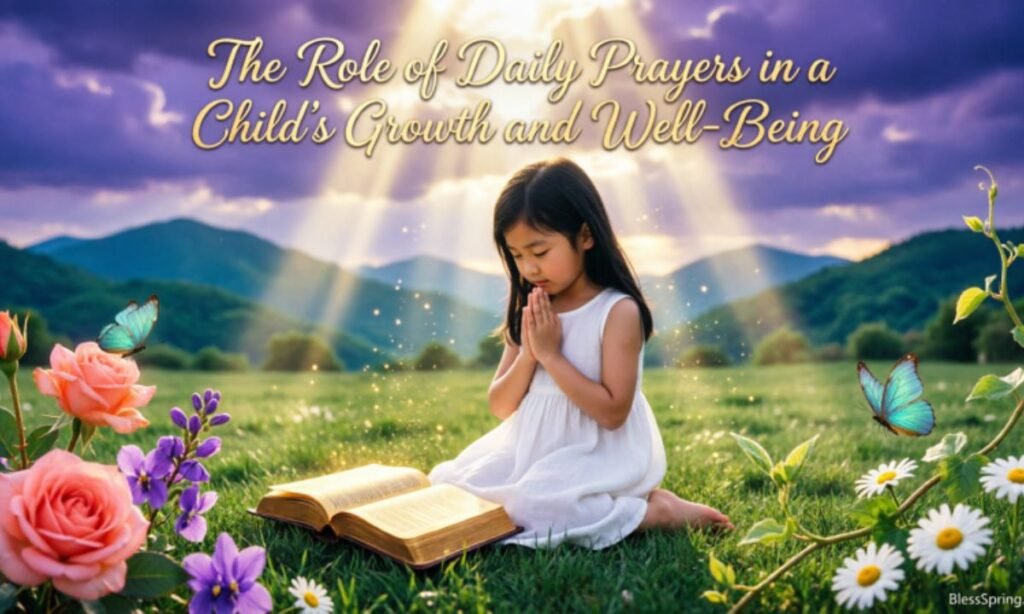
- Daily prayer shapes the emotional and spiritual atmosphere a child grows up in, often before the child even understands the words.
- Short duas recited each morning or before bed become part of a family routine, creating rhythm and a sense of safety.
- Children who witness their parents praying for them tend to develop their own sense of security and personal faith over time.
- The act of praying regularly makes a parent pause and reflect, which often leads to better day-to-day parenting decisions.
- Consistency matters more than length; a short dua repeated daily has more long-term impact than a long dua said occasionally.
- Growth, whether physical, emotional, or spiritual, tends to happen gradually, and daily dua supports that steady process.
Understanding the Concept of Protection in Islamic Teachings
- Protection in Islam covers more than physical safety; it also includes the heart, mind, and soul.
- Physical protection addresses illness, accidents, and the everyday risks that come with childhood.
- Spiritual protection covers unseen dangers such as the evil eye and the influence of shaytan, both addressed directly in the Sunnah.
- The Prophet Muhammad (peace be upon him) is known to have protected his own grandchildren through specific spoken duas.
- Emotional and behavioural protection involves guarding a child from negative influences, unhealthy friendships, and struggles like anxiety or anger.
- A complete approach to protection considers all these layers together rather than focusing on physical safety alone.
How Dua Supports Children Through Life’s Early Challenges
- Early childhood calls for duas focused on health, safety, and general well-being since babies rely entirely on their parents.
- The toddler and early school years bring new challenges such as adjusting to new environments, forming friendships, and managing emotions.
- Duas during this stage often focus on confidence, adaptability, and emotional steadiness.
- As children move into school years, focus and learning become central, leading many parents to make dua for memory and concentration.
- Behavioural challenges are a normal part of growing up, and dua is often paired with patient, loving guidance rather than used as a replacement for it.
- Each stage of childhood carries its own struggles, and dua can be shaped to match exactly what a child is facing at that time.
A Simple Dua for Protection of Children Parents Can Recite Every Day
- The dua “U’eedhu kumaa bikalimaatil laahit taammati min kulli shaytaanin wa haaammatin wa min kulli ‘aynin laammah” is one of the most well-known protection duas in Islamic tradition.
- It translates to: I seek protection for you in the perfect words of Allah, from every devil and every poisonous creature, and from every evil eye.
- This dua was regularly recited by the Prophet Muhammad (peace be upon him) over his grandchildren, Hasan and Husayn.
- It can be recited in the morning before school, at night before bed, or at any moment a parent feels their child needs extra protection.
- The dua requires no specific time, place, or condition, making it easy to include in daily life.
- A parent can whisper it over a sleeping child or say it quietly while dropping them off anywhere outside the home.
Daily Dua for Children’s Health and Safety in Every Situation
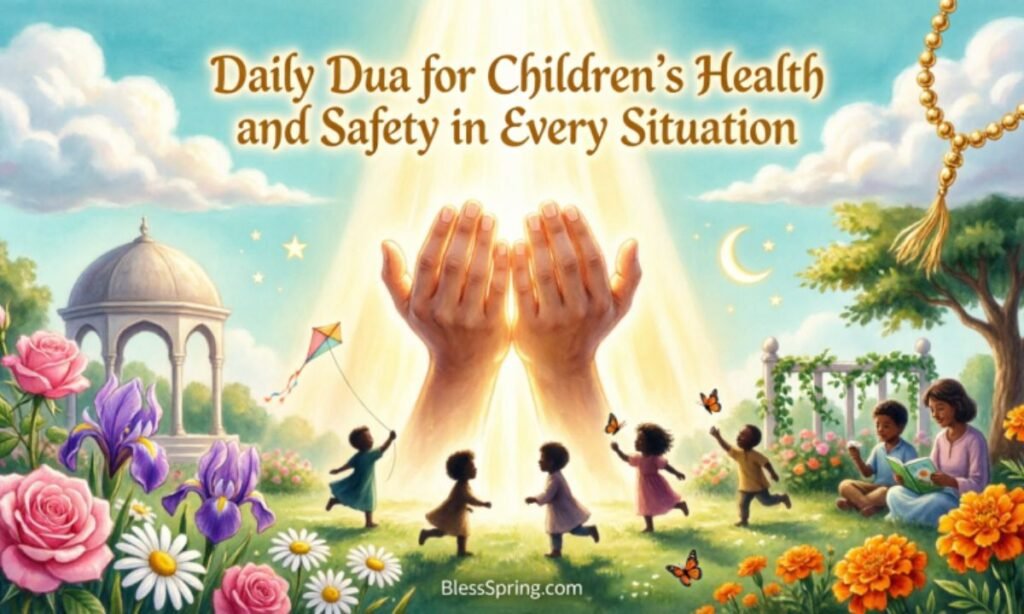
- The dua “Allahumma rabban naas, adhhibil ba’s, ishfihi wa antash shaafi, laa shifaa’a illaa shifaa’uka, shifaa’an laa yughaadiru saqamaa” is specifically taught for times of illness.
- It means: O Allah, Lord of mankind, remove this hardship and grant healing, for You are the Healer, and there is no healing except Your healing.
- This dua can be recited while placing a hand gently on a sick child or said quietly nearby.
- It reflects the belief that medicine plays an important role, but true healing ultimately comes from Allah.
- For daily safety beyond illness, many parents recite Ayatul Kursi along with the last three surahs of the Quran each morning and evening.
- These verses are traditionally treated as a form of spiritual protection for the whole household, including children.
Dua for Newborn Protection and the Importance of Early Spiritual Care
- It is Sunnah to recite the adhan into a newborn’s right ear and the iqamah into the left ear shortly after birth.
- This early act marks the very beginning of a child’s spiritual journey and sets the tone for a faith-centered home.
- The Quranic dua “Rabbana hab lana min azwaajinaa wa dhurriyaatinaa qurrata a’yunin waj’alnaa lilmuttaqeena imaamaa” is commonly recited for newborns.
- It means: Our Lord, grant us from among our spouses and offspring comfort to our eyes, and make us leaders for the righteous.
- Even though a newborn cannot understand the words, regular recitation builds a spiritual atmosphere in the household from day one.
- Many scholars note that a parent’s dua during this vulnerable early period carries especially strong emotional and spiritual weight.
Dua for Children Starting School and Adjusting to New Environments
- Starting school is a major transition that can create anxiety for both the child and the parent.
- A simple dua before drop-off, asking Allah to ease the day and surround the child with kind friends, can help settle early nerves.
- The dua “Rabbi ishrah li sadri wa yassir li amri” is often adapted by parents for their children in new or challenging situations.
- It means: My Lord, expand my chest and ease my task for me; originally the dua of Prophet Musa (AS) when given a difficult mission.
- Alongside dua, gentle verbal reassurance from a parent helps a child feel supported through unfamiliar surroundings.
- Reminding a child that Allah is always with them, even among new faces, builds a lasting sense of security.
Dua for Improving Behaviour in Children with Patience and Wisdom
- Difficult behaviour is a normal part of childhood development, not a reflection of a parent’s failure.
- The dua “Allahumma alhinhu birr waalidayhi wa a’inhu ‘ala ta’atika” asks Allah to soften a child’s heart toward obedience and kindness.
- It means: O Allah, inspire in him kindness to his parents and help him in obedience to You.
- This dua reflects a two-part request, asking Allah to work on the child’s heart while also asking for patience for the parent.
- Islamic teaching repeatedly emphasizes patience as one of the most effective tools available to a parent.
- Pairing patience with sincere dua tends to bring better long-term results than frustration or harsh discipline alone.
Dua for Children to Become Respectful and Emotionally Balanced
- Respectful, emotionally balanced children develop gradually over years, not through a single conversation or correction.
- The dua “Allahumma ij’alhu min ahlil khayri wal barakah” is commonly used to ask Allah for goodness and blessing in a child’s character.
- It means: O Allah, make him among the people of goodness and blessing.
- Emotional balance is closely tied to a child’s overall character and sense of security at home.
- A child who feels loved and spiritually grounded is generally better equipped to manage frustration and disappointment.
- Consistent dua for character, paired with real conversations and emotional support, tends to strengthen a child’s coping skills over time.
Dua for Child Memory, Focus, and Support During Learning
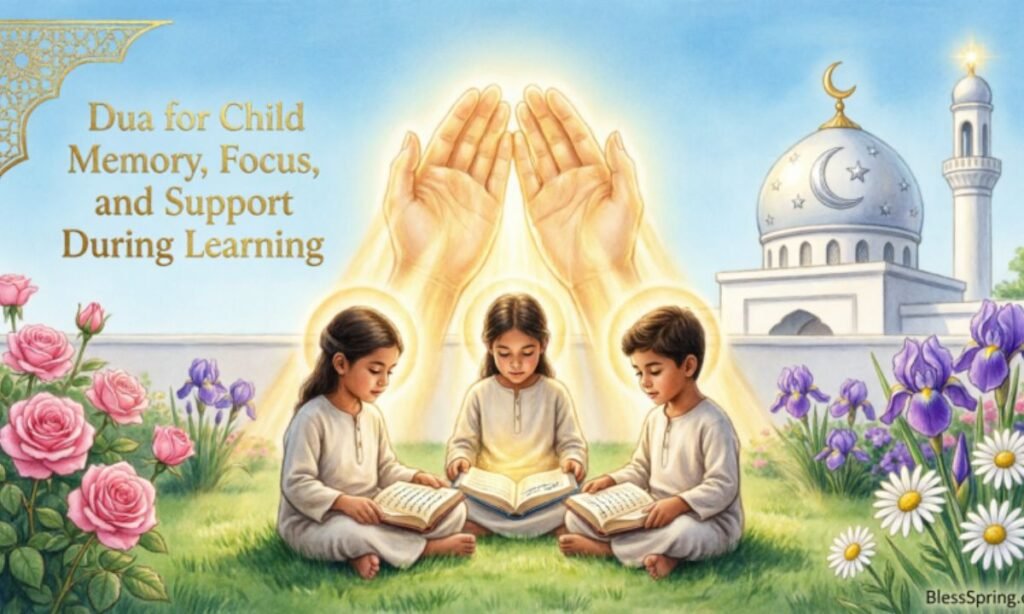
- Academic pressure is a real concern for many parents, making memory and focus a common subject of dua.
- The dua “Rabbi zidni ‘ilmaa” is widely known and used by students and parents alike.
- It means: My Lord, increase me in knowledge.
- Parents can recite this dua on behalf of their child, especially before exams or during periods of heavy study.
- Dua for learning works best alongside practical support, such as a consistent study routine and adequate rest.
- A calm home environment paired with sincere dua often supports a child’s ability to focus and retain information more effectively.
Frequently Asked Questions
What is the most important dua for protecting a child?
The dua taught by the Prophet Muhammad (peace be upon him), seeking refuge for a child in the perfect words of Allah from every devil, harmful creature, and evil eye, is considered one of the most important and widely recited protection duas in Islamic tradition.
Can I make dua for my child without them being present?
Yes, a parent can recite dua for their child at any time, whether the child is present, asleep, or away from home. The sincerity of the dua matters more than the physical presence of the child.
How often should I recite protection duas for my child?
Many parents recite protection duas daily, often in the morning and before bed, though there is no fixed limit. Consistency tends to bring the most comfort and long-term benefit.
Is it necessary to recite duas in Arabic only?
While Arabic is the original language of these duas and carries specific blessings, a parent can also make sincere personal dua in their own language whenever Arabic is not possible.
Can dua help with my child’s behaviour problems?
Dua can support behavioural improvement when paired with patience, consistent guidance, and positive parenting practices. It is not a replacement for active parenting, but a spiritual support alongside it.
What dua can I recite before my child starts school?
A gentle dua asking Allah to ease the child’s heart, protect them, and surround them with good company is commonly recited before school, along with general daily protection duas.
Are there duas specifically for a newborn baby?
Yes, along with the Sunnah practice of reciting the adhan and iqamah after birth, parents often recite Quranic duas asking for their child to become a source of comfort and to grow into righteousness.
Conclusion
Raising a child comes with countless responsibilities, and no parent can predict or control every situation their child will face. This is exactly why dua holds such an important place in Islamic parenting. It offers comfort during uncertain moments, structure through daily spiritual habits, and a sense of partnership with Allah in raising a child who is healthy, safe, and emotionally strong.
From the earliest days of a newborn’s life to the challenges of starting school, learning new subjects, and developing good character, there is a dua suited to every stage. What matters most is sincerity and consistency, not perfection. A parent who makes even a short, heartfelt dua each day is building a strong spiritual foundation for their child, one that will support them long after childhood has passed.

John Howdy is a dedicated author at Bless Spring with over four years of professional writing experience. He specializes in creating informative, engaging, and SEO-friendly content for a global online audience. His work focuses on delivering well-researched insights in a clear and reader-friendly style. Through Bless Spring, John consistently shares valuable articles that educate, inspire, and support digital readers.
